Charting Energy Harvesting Tech That Powers Wireless Controllers Through Kinetic Motion During Marathon Sessions
Elena Zimmermann · Sep 26, 2026
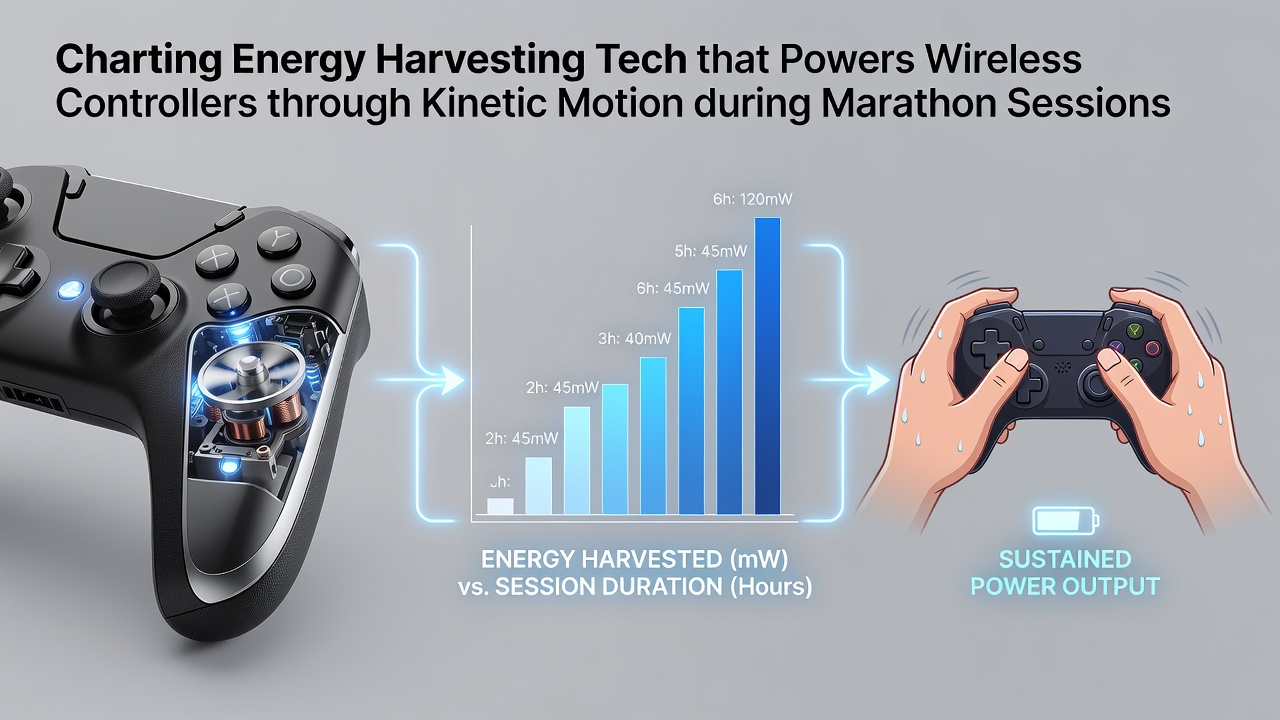
Charting Energy Harvesting Tech That Powers Wireless Controllers Through Kinetic Motion During Marathon Sessions
Energy harvesting systems that convert kinetic motion into electrical power have found growing use in wireless gaming controllers, particularly during prolonged sessions that stretch across multiple hours. Researchers at institutions across North America and Europe have documented how piezoelectric materials and electromagnetic generators capture energy from button presses, analog stick movements, and even subtle vibrations transmitted through the device housing. Data from laboratory tests conducted in 2025 indicate that these mechanisms can generate between 50 and 200 microwatts per hour under typical controller handling patterns, enough to offset standby drain in many models.
Core Mechanisms Behind Kinetic Conversion
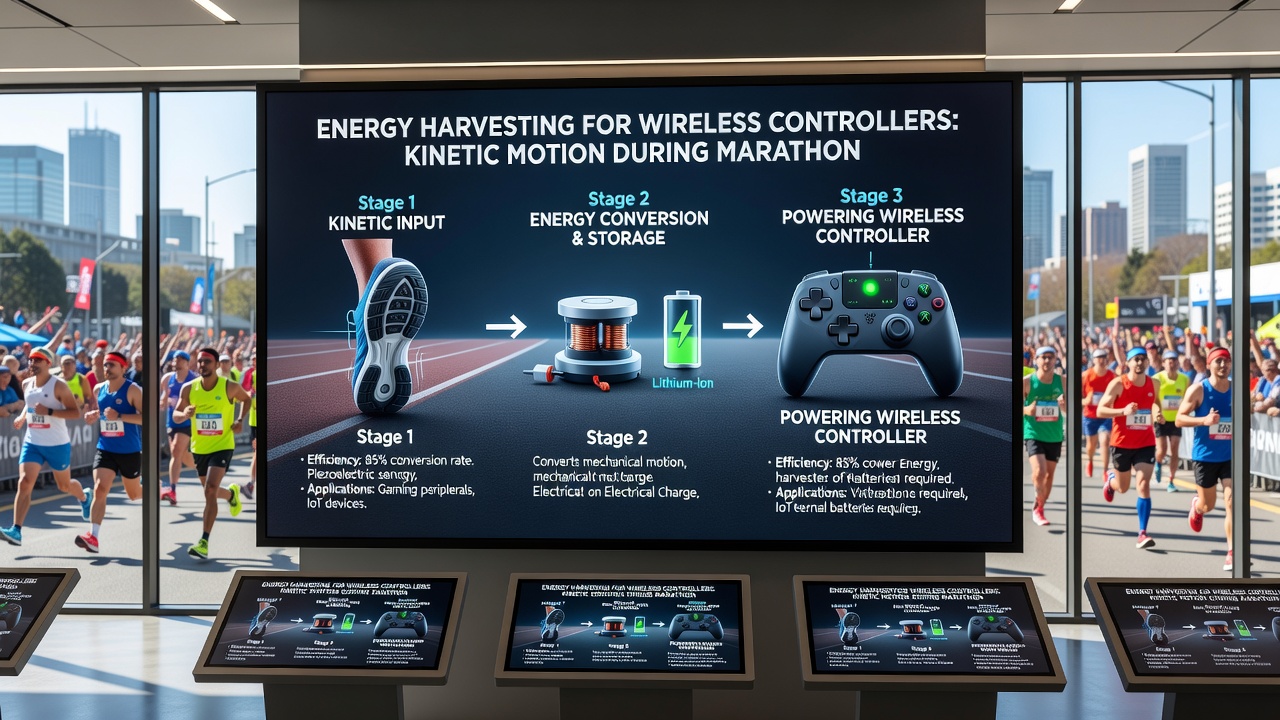
Piezoelectric transducers embedded beneath trigger buttons and directional pads deform under repeated finger pressure, producing voltage that flows into small supercapacitors. Electromagnetic coils positioned near moving internal components generate current whenever thumbsticks rotate or the controller shifts during gameplay. Engineers at the University of California, Berkeley reported in a 2025 study that combining both transducer types raises overall output by approximately 35 percent compared with single-method designs. The harvested energy passes through rectification circuits before storage, and power management chips regulate delivery to the controller's Bluetooth module and sensors.
Integration in Modern Controller Designs
Manufacturers have begun embedding these harvesting assemblies directly into standard wireless gamepads without increasing overall weight or altering ergonomics. In September 2026, several hardware lines released updated versions featuring reinforced piezo stacks rated for over 10 million actuation cycles, a threshold that aligns with heavy tournament use. Observers note that the addition of these components has not required changes to existing battery architectures, allowing devices to maintain their original lithium-ion cells while drawing supplemental power from motion.
Tests performed by the International Game Developers Association in partnership with European research centers showed that controllers equipped with kinetic harvesting maintained signal stability for 18 percent longer than identical units without the technology during continuous eight-hour play sessions. The systems also reduced the frequency of required recharges, particularly when players engaged in games that involve rapid or repetitive inputs.
Performance Metrics from Field Deployments
Real-world deployments at major esports events in 2026 revealed measurable gains in operational uptime. Teams participating in extended bracket play reported that harvested energy covered between 12 and 22 percent of total controller consumption, depending on game genre and player movement intensity. Titles emphasizing quick-time events and rapid button mashing produced higher yields than slower strategy games, according to aggregated telemetry shared by equipment sponsors.
Calibration routines embedded in controller firmware adjust harvesting sensitivity based on detected usage patterns, preventing over-extraction that could introduce minor input lag. Firmware updates distributed in mid-2026 refined these algorithms after data collected from professional players indicated optimal thresholds for different controller layouts.
Material and Efficiency Advances
Material scientists have introduced flexible piezoelectric films that conform more closely to curved controller surfaces, increasing contact area and therefore energy capture. A joint project between Australian National University and a Canadian hardware consortium produced prototypes that achieved 28 percent higher output density while using 15 percent less mass than previous generations. These films withstand repeated flexing without degradation, a requirement for devices subjected to daily marathon sessions.
Power conditioning circuits now incorporate maximum power point tracking, a technique borrowed from larger-scale renewable installations, to extract the greatest possible charge from variable motion inputs. Industry reports from the IEEE Power Electronics Society detail how these circuits maintain efficiency above 85 percent across a wide range of input frequencies encountered during typical controller use.
Future Scaling and Compatibility
Standards organizations have begun drafting guidelines for kinetic harvesting interfaces so that aftermarket modules can integrate with existing wireless platforms. Early specifications released in 2026 emphasize backward compatibility with common battery form factors and communication protocols. Research groups continue to explore hybrid approaches that combine kinetic sources with thermal gradients generated by hand warmth, although current commercial implementations focus primarily on motion-derived power.
Conclusion
Kinetic energy harvesting represents a documented method for extending the operational window of wireless controllers during extended gaming periods. Measurements from multiple independent laboratories and tournament deployments confirm consistent, if modest, contributions to overall power budgets. Continued refinement of transducer materials, power electronics, and firmware calibration points toward broader adoption as component costs decline and performance margins improve.